DeepSeek vs ChatGPT vs Gemini 2026 Camprison: Full Guide
Quick answer: DeepSeek V4-Pro is the cheapest and only self-hostable option of the three, ChatGPT’s GPT-5.5 leads on autonomous coding and tool use, and Gemini 3.1 Pro leads on reasoning, science, and native multimodality at roughly a quarter of GPT-5.5’s price. There’s no single winner — the right pick depends on whether budget, raw capability, or reasoning-per-dollar matters most to you.
Updated: July 2026 • ~12 minute read • Fact checked against official pricing and benchmark sources
Overview
By mid-2026, picking between DeepSeek, ChatGPT, and Gemini isn’t really a question of which one is “smartest” — it’s a question of what you’re willing to trade off. DeepSeek’s V4-Pro model, released in April 2026, ships under an MIT license with downloadable weights and API pricing a fraction of its rivals. OpenAI’s GPT-5.5, released the same week, remains the strongest agentic coder of the three. Google’s Gemini 3.1 Pro, out in February 2026, leads on reasoning and science benchmarks while undercutting GPT-5.5 on price. Each is a genuinely credible pick, and increasingly, teams use more than one. For a look at how Anthropic’s Claude fits into this same landscape, see our guide: Claude vs ChatGPT 2026: Full Pricing & Feature Guide.
Key Takeaways
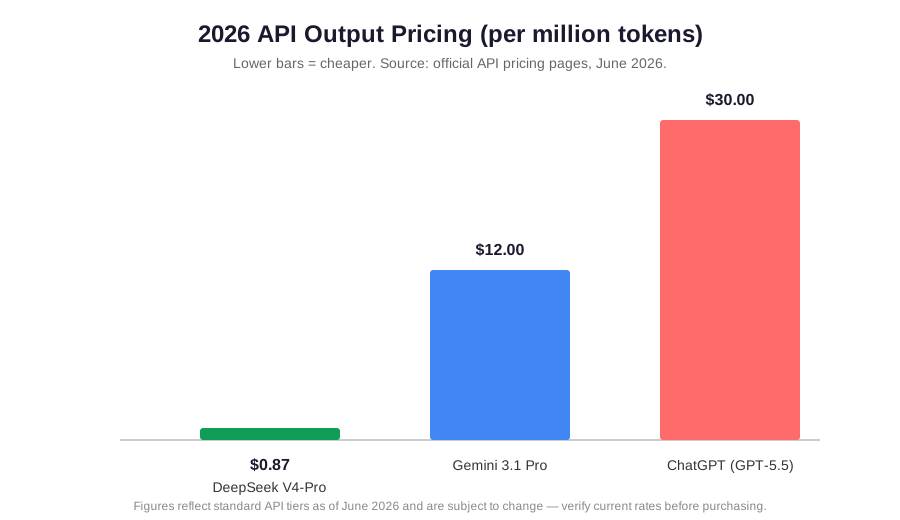
- DeepSeek V4-Pro is dramatically cheaper on the API — roughly 11x less than GPT-5.5 on input tokens and around 34x less on output tokens — and it’s the only one of the three you can legally self-host.
- GPT-5.5 posts the highest score on SWE-Bench Verified (88.7%) and Terminal-Bench 2.0 (82.7%), making it the strongest choice for autonomous coding agents.
- Gemini 3.1 Pro leads on reasoning benchmarks (94.3% on GPQA Diamond, 77.1% on ARC-AGI-2) and is the only one of the three built for native video understanding.
- All three now offer roughly a million-token context window, so context size is rarely the deciding factor anymore.
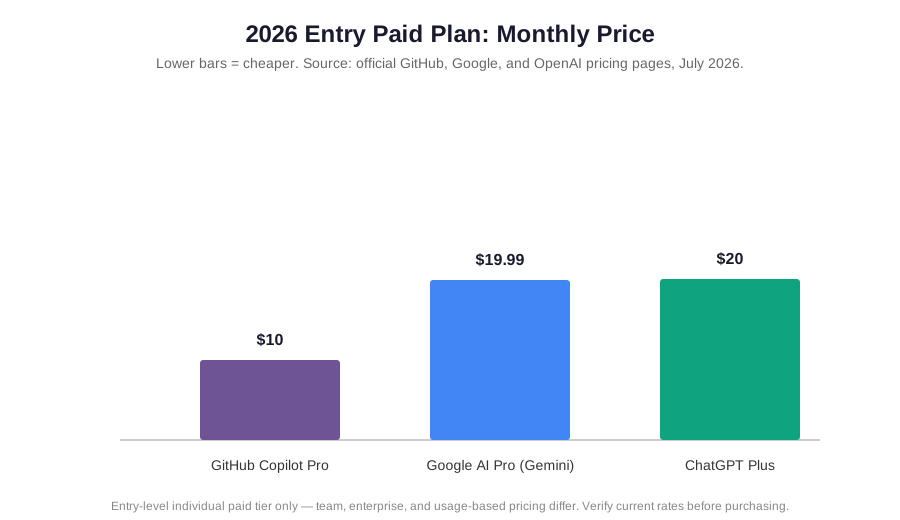
- Consumer subscriptions sit close together — ChatGPT Plus and Google AI Pro are both around $20/month, while DeepSeek’s consumer app is free and monetizes through API usage instead.
Who This Guide Is For
This comparison is written for developers choosing an API to build on, business owners picking a consumer AI subscription, and anyone trying to work out whether a model switch is worth the migration effort. If you just want a one-line recommendation: pick GPT-5.5 when capability is the constraint, Gemini when reasoning-per-dollar matters most, and DeepSeek when cost or data control is non-negotiable.
Why You Can Trust This Guide
The figures in this guide are drawn from each provider’s official pricing and model-card pages, independent benchmark trackers, and reporting from established technology outlets, cross-checked against at least one independent source where possible. We don’t run our own benchmark suite, and we say so plainly rather than implying lab-tested results we don’t have. Where a number “may vary” by region, billing tier, or promotional period, we’ve flagged it instead of stating it as fixed.

Quick Comparison Summary
- Best for autonomous coding: ChatGPT (GPT-5.5) — highest scores on real-world coding and terminal-agent benchmarks.
- Best value / lowest cost: DeepSeek V4-Pro — roughly 11–34x cheaper per token than GPT-5.5, and the only self-hostable model of the three.
- Best reasoning-per-dollar: Gemini 3.1 Pro — leads on science and reasoning benchmarks at less than half of GPT-5.5’s price.
Comparison Table
| Feature | DeepSeek V4-Pro | ChatGPT (GPT-5.5) | Gemini 3.1 Pro |
|---|---|---|---|
| Released | April 24, 2026 | April 23, 2026 | February 19, 2026 |
| Weights | Open (MIT), self-hostable | Closed | Closed |
| Context window | 1,000,000 tokens | 1,000,000 tokens (API) | 1,048,576 tokens |
| API price (input / output, per 1M tokens) | $0.435 / $0.87 | $5.00 / $30.00 | $2.00 / $12.00 |
| Entry consumer plan | Free app; API billed per token | ChatGPT Plus, $20/mo | Google AI Plus, $7.99/mo; AI Pro $19.99/mo |
| Multimodality | Primarily text and code | Text, image, audio | Native text, image, audio, video |
| Signature strength | Cost and openness | Agentic coding | Reasoning and multimodal |
The short version: DeepSeek wins decisively on price and is the only model you can run on your own hardware. GPT-5.5 wins on raw coding and tool-use capability. Gemini 3.1 Pro sits in the middle — cheaper than GPT-5.5, ahead of both rivals on reasoning benchmarks, and the only one of the three natively built to understand video.
Pricing Breakdown
On the API, the gap is not subtle. DeepSeek V4-Pro’s promotional rate is about $0.435 per million input tokens and $0.87 per million output tokens (DeepSeek’s standard list price is higher, so confirm the live rate on its pricing page before budgeting). Gemini 3.1 Pro charges $2.00 and $12.00. GPT-5.5 charges $5.00 and $30.00 — meaning DeepSeek’s promotional rate is roughly 11x cheaper than GPT-5.5 on input and about 34x cheaper on output. Scaled to a workload of 500 million input and 100 million output tokens a month, that difference works out to roughly $300/month on DeepSeek versus around $2,200/month on Gemini and about $5,500/month on GPT-5.5 — real money for any application processing meaningful volume. These are standard API rates and don’t include volume discounts, cached-input pricing, or promotional windows, all of which can shift the math, so treat them as a starting point rather than your final bill. If you’re also weighing this against automating a specific business function, our AI invoice generator breakdown shows how token costs translate into a real workflow budget.
For everyday consumer use, the subscriptions land closer together. ChatGPT Plus and Google’s AI Pro tier are both priced right around $20/month, with Google’s plan bundling extra storage and tooling. DeepSeek’s consumer app is free, with the company monetizing through API usage instead — a distribution strategy that has driven especially strong adoption across Asia.
Benchmark Performance

No single model tops every benchmark. On SWE-Bench Verified, a widely used real-world coding test, GPT-5.5 leads clearly, with Gemini 3.1 Pro and DeepSeek V4-Pro effectively tied behind it — a notable result given DeepSeek’s much lower price. On agentic terminal work, GPT-5.5 pulls further ahead, while DeepSeek trails. Flip to scientific and abstract reasoning benchmarks like GPQA Diamond and ARC-AGI-2, and Gemini takes the lead, with DeepSeek posting a credible but lower score and GPT-5.5 not publishing directly comparable figures. DeepSeek’s own strength shows up in competitive-programming benchmarks like LiveCodeBench and Codeforces ratings, where it performs disproportionately well for its price point.
The practical read: treat benchmark scores as directional, not decisive. A few percentage points on a published leaderboard rarely predicts how a model will perform on your specific data and prompts — running your own small evaluation against a handful of real tasks will tell you more than any comparison table, including this one.
Real-World Scenarios
- A coding agent working through a backlog of GitHub issues. GPT-5.5’s lead on autonomous coding benchmarks makes it the strongest single-pass performer, though its output pricing means costs climb fast at scale. DeepSeek resolves a solid share of the same tickets for a fraction of the cost, trading a bit of completion rate for a much smaller bill.
- A high-volume customer support or back-office workflow. At millions of messages a month, DeepSeek’s low per-token pricing makes it the economically obvious choice; teams automating adjacent functions like AI business automation or AI email marketing run into the same cost-per-message math.
- Analyzing a long document with scanned exhibits, charts, or mixed media. Gemini 3.1 Pro’s native multimodality and large context window make it the least-friction option for ingesting scans, audio, or video alongside text — the same reason it pairs well with tasks like the ones in our best data visualization tools for finance roundup.
- An on-premise deployment where no data can leave the building. Only DeepSeek qualifies, since it’s the only model of the three with downloadable, self-hostable weights.
Pros & Cons
DeepSeek V4-Pro
Pros:
- Dramatically cheaper per token than either rival, even at standard (non-promotional) pricing
- Open MIT-licensed weights — the only one of the three you can self-host or fine-tune
- Strong competitive-programming benchmark scores relative to its price point
- Free consumer app with no subscription tier
Cons:
- Trails GPT-5.5 on long-horizon agentic and terminal-based coding tasks
- Smaller third-party tooling and plugin ecosystem than ChatGPT
- Promotional API pricing has changed before and may revert to standard (higher) rates
- Primarily text/code focused — no native video understanding
ChatGPT (GPT-5.5)
Pros:
- Highest scores on real-world coding and terminal-agent benchmarks of the three
- Most mature developer ecosystem, tooling, and function-calling support
- Broad multimodal support across text, image, and audio
Cons:
- Most expensive of the three on both API input and output pricing
- Closed weights — no self-hosting or on-premise deployment option
- Costs compound quickly on high-volume or long-output workloads
Gemini 3.1 Pro
Pros:
- Leads on reasoning and science benchmarks (GPQA Diamond, ARC-AGI-2)
- Only one of the three with native video understanding
- Roughly 60% cheaper than GPT-5.5 on both input and output tokens
- Slightly larger context window than the other two
Cons:
- More expensive than DeepSeek on a per-token basis
- Closed weights — no self-hosting option
- Trails GPT-5.5 on autonomous coding and terminal-agent benchmarks
Who Should Choose Which
- Choose DeepSeek if you: run a cost-sensitive or high-volume application, need to self-host for data-residency or compliance reasons, or want to fine-tune an open model on your own data — for example, teams building tools like an AI invoice generator where per-document cost matters at scale.
- Choose ChatGPT (GPT-5.5) if you: are building or using an autonomous coding agent where success rate drives revenue, or want the most mature tools and function-calling ecosystem — including workflow-heavy use cases like AI HR software that chain together multiple tool calls.
- Choose Gemini if you: need strong reasoning and native multimodal understanding — video, audio, scanned documents — at a lower price than GPT-5.5, or you’re already embedded in Google Workspace, which suits many AI for small business use cases.
Many engineering teams don’t pick just one. Because all three now expose an OpenAI-compatible chat-completions interface, routing different request types to different models — GPT-5.5 for hard agentic coding, Gemini for multimodal reasoning, DeepSeek for high-volume or cost-sensitive traffic — has become a common 2026 pattern rather than an edge case.
Who Should Not Choose Each One
- Skip DeepSeek if: your workload is a long-horizon coding agent where completion rate matters more than per-token cost, or you need enterprise support SLAs and a mature third-party integration ecosystem — teams building complex chained automations like AI accounting tools may find the gap in agentic reliability costs more than the token savings.
- Skip ChatGPT (GPT-5.5) if: your workload is high-volume and cost-sensitive, since output pricing at $30 per million tokens compounds quickly, or you have a hard requirement to self-host or fine-tune on your own infrastructure.
- Skip Gemini if: your top priority is the lowest possible per-token cost — DeepSeek undercuts it substantially — or your workload leans heavily on autonomous coding and terminal-agent tasks where GPT-5.5 currently scores higher.
Common Mistakes to Avoid
- Comparing consumer subscription price alone. ChatGPT Plus and Google AI Pro are priced within a dollar of each other, but if you’re building an application, the API pricing table above is what actually determines your unit economics — the fix is to model your expected token volume before committing.
- Assuming the cheapest model is always the right call. DeepSeek’s price advantage is real, but it currently trails on long-horizon agentic tool use — the fix is to weigh cost against your tolerance for retries and human review, not price in isolation.
- Ignoring data-residency requirements until after you’ve built on a closed model. Only DeepSeek’s weights are downloadable; GPT-5.5 and Gemini are API-only — the fix is to confirm your compliance requirements before you pick a provider, not after.
Overall Verdict
There’s no single winner here, and any guide that claims otherwise is oversimplifying. GPT-5.5 wins on raw capability, particularly autonomous coding — if your application’s success rate drives revenue and budget is secondary, the premium is often worth paying. Gemini 3.1 Pro wins on balanced value, pairing strong reasoning scores and native multimodality with pricing well below GPT-5.5, making it a safe default for a broad range of teams. DeepSeek V4-Pro wins on cost and control, matching Gemini’s coding benchmark score at a fraction of the price while being the only model you can run on your own infrastructure. If you only remember one thing: match the model to the constraint that matters most to you — capability, reasoning-per-dollar, or cost and control — rather than looking for one model that wins on every axis.
FAQs
Is DeepSeek better than ChatGPT in 2026?
It depends on the task. GPT-5.5 leads on autonomous coding and tool use, so it’s the stronger pick for software-engineering agents. DeepSeek V4-Pro is far cheaper and the only self-hostable option of the two, which makes it the better choice for high-volume or privacy-sensitive workloads.
How much cheaper is DeepSeek than GPT-5.5 and Gemini?
On the API, DeepSeek V4-Pro’s promotional rate is roughly 11x cheaper than GPT-5.5 on input tokens and about 34x cheaper on output tokens, and roughly 4–5x cheaper than Gemini 3.1 Pro on input. The exact multiple depends on your input-to-output token ratio and current DeepSeek pricing, so calculate it against your own workload rather than assuming a flat discount.
Which model is best for coding?
GPT-5.5 currently posts the highest scores on real-world coding benchmarks like SWE-Bench Verified and Terminal-Bench. DeepSeek V4-Pro is close behind on some coding benchmarks at a much lower price, making it a strong value pick if you can tolerate slightly more human review of its output.
Can I run any of these models on my own servers?

Only DeepSeek. Its V4-Pro model is released under an MIT license with downloadable weights, so it can be self-hosted, fine-tuned, and run air-gapped. GPT-5.5 and Gemini 3.1 Pro are closed models available only through their providers’ hosted APIs.
Do these models have different context window sizes?
Not meaningfully. DeepSeek and GPT-5.5 both offer around 1,000,000 tokens of context, and Gemini 3.1 Pro offers slightly more at roughly 1,048,576 tokens. All three can hold a large codebase or a book-length document in a single prompt, so context size is rarely the deciding factor between them in 2026.
Review Methodology
This guide compares publicly published pricing, model-card specifications, and third-party benchmark results current as of late June 2026. We did not run our own benchmark suite or hands-on testing, and figures above are presented as reported by vendors and trackers, cross-checked against at least one independent source where possible. AI provider pricing and benchmark scores change frequently — verify current numbers on each provider’s official site before making a purchasing or engineering decision.
Last Reviewed: July 2026 | Last Updated: July 2026 | Next Scheduled Review: January 2027