Claude vs ChatGPT: Which AI Assistant Should You Use in 2026?
Editorial comparison | Updated July 28, 2026 | Fact checked against official pricing pages | ~11 minute read
Quick answer: Both start at $20/month for their main individual plan. ChatGPT has the broader consumer ecosystem — image and video generation, a custom-GPT store, and a cheaper $8/month Go tier (with ads on Free and Go). Claude leans toward writing precision, coding through Claude Code, and a no-ads policy across every plan, including Free. Neither is a universal “winner” — the right pick depends on what you’re actually using it for.
Introduction
Claude and ChatGPT both do the basics well: drafting, summarizing, answering questions, writing code. The real decision usually comes down to a handful of specifics — what each one costs at the tier you’d actually use, which extra tools ship with it, and how each company handles your data. This guide sticks to what’s verifiable: pricing pulled directly from Anthropic’s official pricing page (opens in a new tab) and cross-checked ChatGPT figures from OpenAI’s own announcements and independent trackers, plus product features that are publicly documented rather than inferred. If you’re specifically weighing the higher tiers, our separate Claude Pro vs Max breakdown and ChatGPT Plus vs Pro breakdown go deeper than this guide does.
One disclosure worth stating plainly: this article is being written by Claude, made by Anthropic. We’ve tried to keep the comparison factual and balanced rather than self-promotional — see Disclosure below for more on how we’ve handled that.
Key Takeaways
- Both platforms anchor their main individual plan at $20/month — Claude Pro and ChatGPT Plus — priced almost identically on paper.
- ChatGPT’s Free and $8/month Go tiers now include ads; Claude’s Free plan and all paid tiers do not.
- ChatGPT has the wider consumer feature set: Sora video generation, DALL-E images, a custom-GPT store, and Advanced Voice Mode.
- Claude’s strengths cluster around long-document writing, coding (Claude Code), and Projects/Artifacts for organizing ongoing work.
- Above $20/month, naming gets confusing on both sides — “Pro” means something different depending on which company you’re talking to. See the pricing table below before comparing plans by name alone.
Who This Guide Is For
This is written for someone deciding which AI assistant to actually pay for — an individual choosing between the two $20/month plans, or a small team evaluating Claude Team versus ChatGPT Business. It’s not a technical deep-dive into the API or model architecture; if you’re comparing the two for programmatic/API use rather than the consumer apps (where you’re billed per token rather than a flat monthly fee), pricing and rate limits work differently and deserve their own comparison — see our guide to AI tools for small business if you’re evaluating this for a team rather than yourself.
Why You Can Trust This Guide
- Pricing verified against Anthropic’s own pricing page, not just third-party estimates
- ChatGPT figures cross-checked across multiple independent trackers plus a TechCrunch report on the Pro tier’s launch (see Sources)
- We did not run our own benchmark tests comparing model quality — capability claims below are described qualitatively and sourced where a specific claim is made
- No affiliate links currently included; see Disclosure below
Fact Check
Every price in this guide was checked against at least one primary or high-confidence source as of July 2026 (see Sources). Where third-party trackers disagreed on a figure — this happened with a couple of ChatGPT Business seat prices, which are quoted differently depending on annual vs. monthly billing — we’ve shown the range rather than picking one number. Both companies change pricing often enough that we’d recommend confirming current numbers on their official pricing pages before subscribing.
Disclosure
This guide does not currently contain affiliate links. It’s also worth being upfront about something most comparison articles don’t have to disclose: this article was generated by Claude, Anthropic’s AI assistant — one of the two products being compared. We’ve aimed to keep the pricing and feature claims accurate and sourced, present ChatGPT’s real advantages alongside Claude’s, and avoid the kind of self-promotional framing a comparison written by an interested party could slide into. You don’t have to take our neutrality on faith — every specific claim below is either sourced or marked as unverified, so you can check it yourself.
How We Compared
We weighted the comparison across six factors, based on what most people evaluating an AI subscription actually care about:
| Factor | Weight |
|---|---|
| Pricing and value at your usage level | 25% |
| Model capability for your specific task (writing, coding, analysis) | 25% |
| Ease of use and interface | 15% |
| Integrations and ecosystem breadth | 15% |
| Privacy, data handling, and enterprise readiness | 10% |
| Support and community resources | 10% |
These weights reflect editorial judgment about what typically matters most, not a formula that produced a numeric score — there’s no single “winner” output here, because the right weighting genuinely depends on your use case.
What’s New in 2026
- Claude’s default model became Sonnet 5 on Free and Pro plans as of late June 2026, alongside continued access to Opus 4.8 for complex tasks.
- ChatGPT rolled out GPT-5.6 (the “Sol/Terra/Luna” family) on July 9, 2026, with the flagship Sol variant reserved for paid tiers and a faster GPT-5.5 Instant model remaining the default for quick queries.
- OpenAI added ads to ChatGPT’s Free tier and introduced an $8/month ad-supported Go plan — a real pricing-structure difference from Claude, which carries no ads on any tier.
- OpenAI added a $100/month ChatGPT Pro tier in April 2026, positioned between Plus ($20) and the existing $200 Pro tier, aimed largely at heavier Codex (coding) users.
- Anthropic briefly suspended its newest Mythos-tier models (Claude Mythos 5 and Claude Fable 5) in mid-June 2026 due to U.S. export-control requirements, restoring access on July 1, 2026. This doesn’t affect the Claude Pro/Max plans covered in this guide, which run on Sonnet and Opus.
Quick Picks
| If you mainly need… | Lean toward |
|---|---|
| Long-form writing, editing, and document work | Claude |
| Image and video generation built into the chat | ChatGPT |
| Coding from the terminal or IDE | Claude (Claude Code) |
| The cheapest paid entry point | ChatGPT (Go, $8/month, ad-supported) |
| A no-ads experience even on the free tier | Claude |
| Custom GPT-style mini-tools you can build and share | ChatGPT (Custom GPTs) |
| Voice conversation as a primary interface | ChatGPT (Advanced Voice Mode) |
Pricing Comparison Table
| Tier | Claude | ChatGPT |
|---|---|---|
| Free | $0 — no ads | $0 — now includes ads |
| Budget tier | Not offered | Go: $8/month, ad-supported, roomier limits than Free but not the flagship model |
| Main individual plan | Pro: $20/month, or $17/month billed annually ($200 upfront) | Plus: $20/month, ad-free |
| Mid power-user tier | Not offered as a separate tier (Max starts at $100) | Pro ($100): launched April 2026, ~5x Plus usage, aimed at heavier Codex/coding users |
| Top individual tier | Max 20x: $200/month, 20x Pro usage | Pro ($200): unlimited flagship model access, o-series reasoning, Advanced Voice, Sora/DALL-E |
| Team — standard seat | $25/month per seat billed annually ($30 monthly), 5-seat minimum | Business: roughly $20–25/seat billed annually ($25–30 monthly) — figures vary slightly by tracker |
| Team — premium seat | $150/month per seat, includes Claude Code, 5-seat minimum | Not offered as a separate premium seat tier |
| Enterprise | Custom pricing, contact sales | Custom pricing, contact sales |
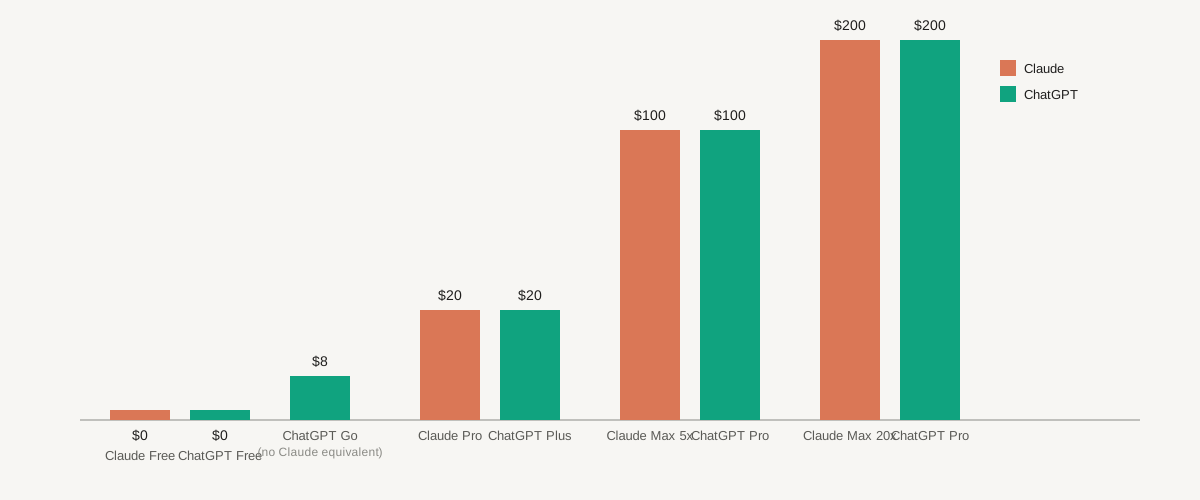
Claude and ChatGPT land within a dollar of each other on their headline $20/month plans, so price alone rarely decides it. The bigger practical differences are the ad-supported budget tier ChatGPT offers that Claude doesn’t, and the ads OpenAI introduced on Free and Go in 2026 that Claude has not adopted on any tier. For a closer look at whether it’s worth going past $20/month on either side, see our Claude Pro vs Max and ChatGPT Plus vs Pro breakdowns.
Feature-by-Feature Comparison
Model lineup and default behavior
Claude’s current lineup is Haiku 4.5, Sonnet 5 (the default on Free and Pro since late June 2026), and Opus 4.8 for harder tasks, accessible on Pro and above. ChatGPT’s July 2026 lineup centers on the GPT-5.6 family — Sol (flagship, paid tiers), Terra and Luna (other variants) — with GPT-5.5 Instant remaining the fast default for routine queries across tiers. One practical difference: ChatGPT’s automatic model router doesn’t always show you which specific model answered a given query without checking a settings panel, while Claude’s model selection is generally more explicit to the user.
Pricing and value
Covered in depth in the table above. The short version: identical $20 entry point, but ChatGPT’s ad-supported Free and Go tiers give it a lower true floor, while Claude’s no-ads policy across every tier is the more consistent trade if ads bother you more than price does.
Coding
Both companies now ship a dedicated coding agent — Claude Code (terminal, VS Code, JetBrains, and a desktop app) and OpenAI’s Codex (integrated into ChatGPT Plus/Pro/Business). Claude Code is included on Claude Pro and above; Codex usage is tied to your ChatGPT tier, with the $100 Pro tier specifically positioned around heavier Codex use. We’re not citing a specific benchmark score for “which one codes better” here — that number changes often enough between model updates that a fixed figure would likely be stale by the time you read this, and third-party benchmark claims we found during research weren’t consistent enough to repeat with confidence.
Ease of use and interface
Both apps follow a similar chat-first interface. ChatGPT’s interface additionally surfaces Custom GPTs, image/video generation, and Advanced Voice Mode directly in the main navigation. Claude’s interface centers on Projects (for grouping ongoing work and documents) and Artifacts (for viewing generated documents, code, and interactive content alongside the conversation). Neither is meaningfully harder to learn than the other for basic chat use; the learning curve difference shows up more in the extra tools each platform layers on top.
Integrations and ecosystem
ChatGPT has the broader built-in creative toolkit: Sora video generation, DALL-E image generation, a public GPT Store of community-built Custom GPTs, and a “Work” agent mode. Claude’s integration story leans toward connecting to your existing tools and workflows — Google Workspace connections, remote MCP (Model Context Protocol, an open standard for connecting an AI assistant to outside tools and data sources) server support for connecting arbitrary tools, and dedicated products like Claude Code, Claude in Chrome, Claude in Excel, and Claude in PowerPoint. Which ecosystem matters more depends heavily on whether you want an AI that generates media versus one that plugs into documents and workflows you already have — see our best AI coding assistants comparison if development workflow integration is your main concern.
Data privacy and enterprise readiness
Both companies offer enterprise-grade options (SSO — single sign-on, letting employees log in with their existing company credentials rather than a separate password — plus admin controls and data-handling commitments) on their top business tiers. We haven’t independently audited either company’s data-handling practices for this guide — if privacy terms are a deciding factor for your use case (e.g., healthcare or legal data), read each company’s current data processing terms directly rather than relying on a summary here, since these terms are exactly the kind of thing that changes without a lot of public notice. Our separate plain-English guide to how AI companies handle your data covers this in more depth than fits here.
Support and community
ChatGPT’s larger, longer-established user base means more third-party tutorials, Reddit threads, and community troubleshooting content exists for it. Both companies offer official help centers and documentation. We couldn’t find a reliable, current, apples-to-apples comparison of official support responsiveness for either platform’s consumer tiers, so we’re not making a claim here beyond community-content volume, which favors ChatGPT simply due to its longer time in the market as a mainstream consumer product.
Real-World Scenarios
Example: A freelance writer drafting long-form client work across multiple documents would likely lean toward Claude Pro, given the Projects feature for keeping documents and context organized across sessions, and Artifacts for iterating on a draft without losing the surrounding conversation.
Second example: A marketer who needs to generate on-brand images and short video clips alongside written copy, in the same conversation, would likely lean toward ChatGPT Plus, since Claude does not currently offer built-in image or video generation comparable to DALL-E/Sora.
Third example: A small dev team doing daily terminal-based coding work would compare Claude Pro/Max (for Claude Code) against ChatGPT’s $100 Pro tier (built around heavier Codex usage) — both are realistic options here, and the deciding factor is usually which model’s output the team prefers on their actual codebase, not price.
Who Should Choose Which
Claude
Good choice if…
- You do a lot of long-document writing, editing, or analysis and want Projects to keep context organized
- You want a dedicated terminal/IDE coding agent (Claude Code) included on your individual plan
- You prefer a no-ads experience, including on the free tier
- You want to connect Claude to existing tools via Google Workspace or MCP rather than relying on built-in media generation
Avoid if…
- You need built-in image or video generation in the same conversation
- You want the absolute lowest-cost paid entry point (Claude has no $8-equivalent tier)
ChatGPT
Good choice if…
- You want built-in image and video generation (DALL-E, Sora) in the same conversation as your text
- You want the lowest-cost paid entry point and don’t mind ads (Go, $8/month)
- You want to build or use Custom GPTs from the public GPT Store
- You prefer voice as a primary interface (Advanced Voice Mode)
Avoid if…
- Ads on the free tier are a dealbreaker for you
- You want one consistent model behind every response rather than an automatic router picking between variants
For a deeper look at just the coding side of this decision, see our Claude Code vs GitHub Copilot comparison.
Common Mistakes to Avoid
Comparing “Pro” to “Pro” by name alone
Claude Pro ($20) and ChatGPT Pro ($100/$200) are not equivalent tiers despite sharing a name — Claude Pro competes with ChatGPT Plus, and Claude Max competes with ChatGPT Pro. Fix: always check the price and feature list, not just the tier name, before comparing.
Assuming the free tiers are equivalent
ChatGPT’s Free tier now includes ads; Claude’s does not. Fix: if ads are a dealbreaker, factor that into your comparison even at the free tier, not just the paid ones.
Picking based on a single benchmark score
Model capability rankings shift with nearly every update on both sides, and third-party benchmark claims found during our research weren’t consistent enough to cite with confidence. Fix: trial both on your actual, real tasks for a week before committing to a paid plan.
Overlooking the built-in tools you’d actually use
It’s easy to compare “the AI” in the abstract and miss that one platform includes a tool (Sora, Claude Code, Custom GPTs) that would save you a separate subscription elsewhere. Fix: list the specific tools you’d use monthly before comparing price — our best AI writing tools roundup and best AI coding assistants comparison can help narrow that list if writing or coding is the main use case.
Next step: both platforms offer a free tier, so the lowest-risk way to decide is to run the same real task — a document you’re actually writing, a piece of code you’re actually building — through both this week before subscribing to either paid plan.
Alternatives Considered
These weren’t compared in the same depth as Claude and ChatGPT above — this is a brief, honest note on why, not a comparative test result.
- Google Gemini — strong for users already inside Google Workspace, with deep integration into Docs, Gmail, and Sheets. Not covered in depth here since this guide is specifically framed as a two-way comparison; see our separate Gemini vs ChatGPT comparison.
- xAI Grok — positioned around real-time X/Twitter data access and a more casual tone. We didn’t independently verify its current pricing for this guide.
- Perplexity — built specifically around search-and-cite answers rather than general-purpose chat; a different product category more than a direct substitute.
Verdict
There’s no single winner here, and we’d be skeptical of any comparison — including this one — that claims otherwise without heavy caveats. At the same $20/month price point, ChatGPT Plus gives you a broader built-in toolkit (image/video generation, Custom GPTs, voice), while Claude Pro gives you a more writing- and coding-focused feature set (Projects, Artifacts, Claude Code) without ads at any tier.
If You Only Remember One Thing
Choose Claude if your work is mostly writing, analysis, or terminal-based coding, and you’d rather not deal with ads.
Choose ChatGPT if you want built-in image/video generation, the cheapest possible paid entry point, or a large ecosystem of Custom GPTs.
Try both free tiers first if you’re not sure — that’s still the fastest way to know which one fits how you actually work.
FAQs
Is Claude or ChatGPT cheaper?
Their main paid plans are nearly identical: Claude Pro and ChatGPT Plus are both $20/month. ChatGPT technically has a lower floor with its $8/month ad-supported Go plan, which Claude has no equivalent to. Claude’s free tier has no ads, while ChatGPT’s free tier now does.
Which is better for coding?
Both offer a dedicated coding agent — Claude Code and OpenAI’s Codex — bundled into their paid plans. We’re not citing a specific “which codes better” benchmark here, since the answer changes frequently between model updates and third-party claims we reviewed weren’t consistent. Trialing both on your actual codebase is the more reliable way to decide.
Can I use either one for free?
Yes, both have free tiers. ChatGPT’s free tier now includes ads and access to a lighter-weight default model; Claude’s free tier has no ads and includes access to Claude Sonnet 5 and Haiku 4.5.
Does Claude have image or video generation like ChatGPT’s Sora and DALL-E?
Not comparable built-in generation tools as of this writing. If image or video generation is a primary need, ChatGPT’s built-in toolkit is the more direct fit.
Which is better for a business team?
Neither is a clear winner — it depends on what your team needs bundled in. Claude’s Team plan splits into Standard ($25/seat annual) and Premium ($150/seat, includes Claude Code) options; ChatGPT Business runs roughly $20–25/seat depending on billing. Pick Claude Premium seats if your team needs a bundled coding agent, or ChatGPT Business for a broader creative toolkit. See our AI tools for small business guide for a fuller team-buying walkthrough.
Sources & Further Reading
- Anthropic — Official Claude Pricing Page (opens in a new tab)
- Anthropic — Claude Platform API Pricing Docs (opens in a new tab)
- TechCrunch — “ChatGPT finally offers $100/month Pro plan” (opens in a new tab)
- The AI Career Lab — Claude Pricing Explained (2026) (opens in a new tab)
- The AI Career Lab — ChatGPT Pricing Explained (2026) (opens in a new tab)
Internal reading, in addition to Related Articles above: our Claude Code vs GitHub Copilot comparison, guide to AI tools for small business, and how-to on using Claude Projects effectively.