Best ChatGPT Prompts (2026): Templates and Examples for Every Goal
Quick answer: The best ChatGPT prompts are specific and matched to the task: creative-writing prompts for storytelling, focused Q&A prompts for quick answers, educational prompts for learning complex topics, and task-oriented prompts for ChatGPT’s agentic Work mode. Specificity — not clever wording — is what actually separates a strong prompt from a weak one.
What are ChatGPT prompts?
A ChatGPT prompt is simply the instruction you give the model to get a specific kind of output. The effectiveness of your interaction depends largely on how well you write that instruction — a vague prompt tends to produce a vague, generic answer, while a specific one guides the model toward something you can actually use. This isn’t unique to ChatGPT; it’s how every large language model works, but it matters most in the moment you’re actually trying to get something done.
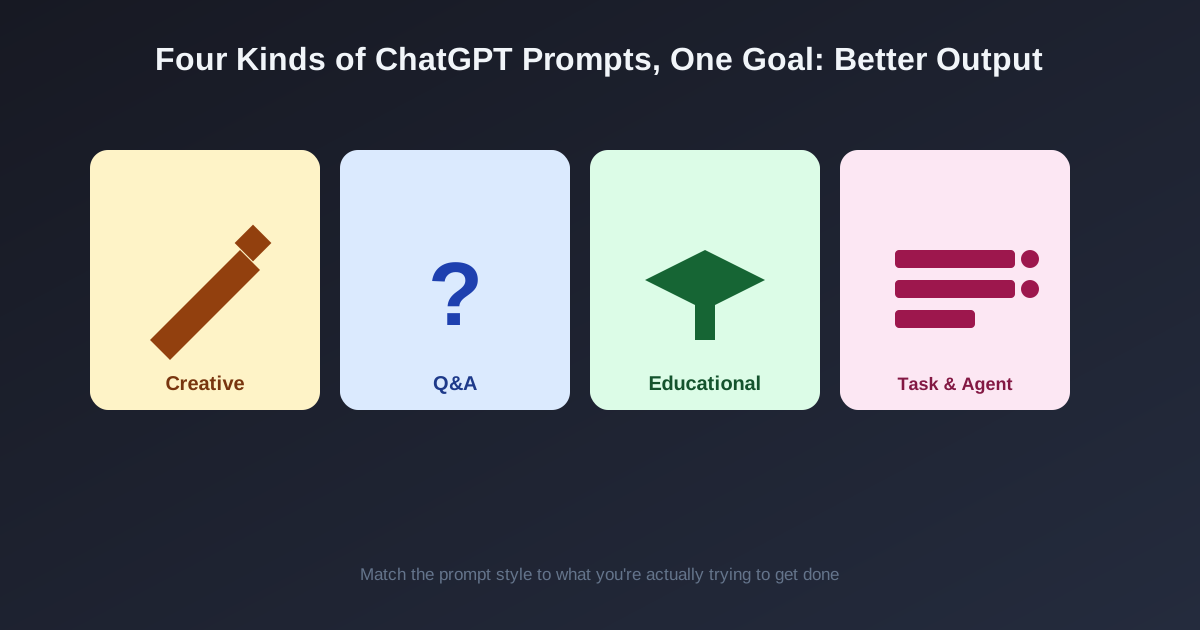
This guide organizes the best-performing prompt types by goal rather than by novelty, since most “100 ChatGPT prompts” lists mix genuinely useful patterns with filler. Whether you’re drafting fiction, looking for a quick factual answer, studying a difficult subject, or handing ChatGPT’s Work agent a multi-step task, there’s a prompt structure suited to it — and knowing which one to reach for saves you several rounds of back-and-forth.
Editorial note: This article was reviewed by the TribunePK editorial team and fact-checked against official documentation and trusted industry sources before publication. Learn more about our Editorial Policy.
Who this guide is for
This is written for regular ChatGPT users — writers, students, professionals, and small-business owners — who want a practical reference for getting better output, not a developer’s guide to the API. If you’re building prompts programmatically for an application, OpenAI’s own developer documentation (linked in Sources) goes deeper into system-message design and testing than this guide does.
Why you can trust this guide
The prompting principles in this guide are drawn from OpenAI’s own published prompt engineering documentation, cross-checked against independent testing and reporting from prompt-engineering practitioners published in 2026. Where guidance has genuinely changed — like the nuance around chain-of-thought prompting on newer reasoning models — that’s called out explicitly rather than repeated as unchanging advice.
Fact check
Core prompting techniques referenced here (clear instructions, reference examples, task decomposition) are documented directly in OpenAI’s official prompt engineering guide and help-center article, both linked in Sources. Claims about model-specific behavior — such as how GPT-5-family models route between fast and reasoning modes — reflect OpenAI’s own developer documentation as of July 2026 and may shift as the model family is updated further.
Disclosure
This article contains outbound links to OpenAI’s own documentation and independent reporting used for verification. It does not contain affiliate links, and this site has no financial relationship with OpenAI that influenced this guide.
What’s new since our last update
- ChatGPT Work, OpenAI’s new agent for multi-step task execution, has created a genuinely new category of prompt — one written to define a goal and constraints for an agent to plan against, rather than a single question-and-answer exchange.
- Guidance on chain-of-thought prompting has gotten more nuanced. Because newer GPT-5-family models route between faster and deeper reasoning modes automatically, explicitly telling the model to “think step by step” can sometimes trigger unnecessary deep reasoning on a simple task, adding latency without improving the answer.
- Structured-output prompting has become more common for anyone using ChatGPT to produce content meant to feed into another tool — specifying an exact format (a table, a numbered list, a fixed word count) up front reduces the need for follow-up reformatting requests.
Quick picks
- Best overall: Creative Writing Prompts
- Best for quick answers: Simple Q&A Prompts
- Best for learning: Educational Content Prompts
- Best for getting things done: Agentic/Task Prompts (ChatGPT Work)
Comparison table
Here’s a quick look at where each prompt style earns its keep:
| Prompt type | Strengths | Ideal users |
|---|---|---|
| Creative Writing Prompts | Inspires ideas, breaks through writer’s block, opens up new genres and angles | Writers, content creators, hobbyist storytellers |
| Simple Q&A Prompts | Fast, focused, concise information with minimal back-and-forth | Students, professionals needing a quick answer |
| Educational Content Prompts | Simplifies complex topics, adapts to a specific learning level | Students, educators, self-directed learners |
| Agentic/Task Prompts | Defines a goal for ChatGPT Work to plan and execute across multiple steps | Professionals delegating multi-step, deliverable-based work |
The short version: reach for a creative prompt when you want ideas, a Q&A prompt when you already know the question, an educational prompt when you need something explained at your level, and an agentic prompt when you want ChatGPT to produce a finished deliverable rather than just an answer.
Individual picks, reviewed
Creative Writing Prompts

Creative writing prompts exist to inspire and push past writer’s block. A prompt like “Write a story about a time traveler who visits the year 3050” works because it’s specific enough to give the model a starting point while leaving the actual narrative choices open. That balance — specific enough to guide, open enough to interpret — is what separates a useful creative prompt from a flat one.
You can push further by mixing genres or constraints: “Write a romantic story set in a post-apocalyptic world” or “Write a dialogue between two characters from different centuries” both tend to produce more distinctive output than a single-genre request, simply because the model has to reconcile two ideas instead of following one familiar pattern. Character-focused prompts work the same way — “Describe a character who has a secret that could change everything” pushes toward motivation and interiority rather than plot mechanics alone.
Compared with Q&A prompts, creative prompts tolerate — and benefit from — more ambiguity; over-specifying a creative prompt can flatten the output into something formulaic.
Simple Q&A Prompts
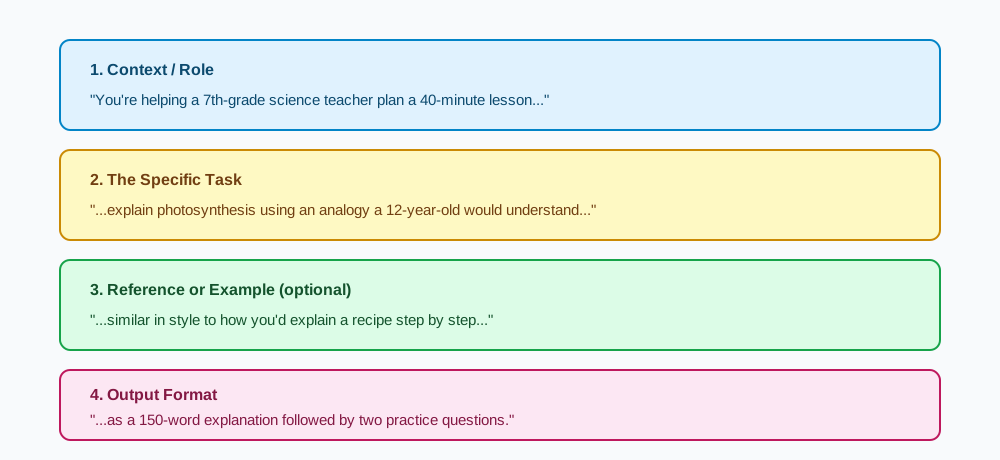
Q&A prompts are for when you already know exactly what you want to know and just need it stated clearly. “What are the main causes of climate change?” is a reasonable starting point, but unlike creative prompts, Q&A prompts reward narrowing rather than broadening — “What were the key events of World War II?” beats “Tell me about history” because it gives the model an actual scope to work within instead of an entire subject.
Follow-up questions extend this well: after asking about a historical event, a natural next prompt might be “What were the effects of these events on modern geopolitics?” — building on established context rather than starting a fresh, disconnected question. Asking for concrete examples works similarly: “What are some successful initiatives to reduce carbon emissions?” invites a more actionable answer than the original broad question alone.
Educational Content Prompts
Educational prompts are built to make a complex topic accessible — “Explain the theory of relativity in simple terms” is the archetype. Unlike a Q&A prompt, an educational prompt usually benefits from specifying the audience’s level explicitly: “explain it the way you would to a high schooler” produces a meaningfully different (and often more useful) answer than the same request with no stated level.
Students get the most out of this style by connecting a prompt to a real point of confusion rather than a generic topic — “Can you explain derivatives with a real-life application?” tends to land better than “explain derivatives,” because it forces the model to ground an abstract concept in something concrete. Prompts that ask for historical or causal context work the same way: “What developments led to the creation of the United Nations?” produces more useful scaffolding than a request for a bare definition.
Educational prompts can also be aimed at critical thinking rather than pure explanation — “Discuss the implications of AI on future job markets” pushes toward analysis and synthesis rather than recall, which is useful for older students or general adult learners.
Agentic/Task Prompts (for ChatGPT Work)
This is the newest category, built around ChatGPT’s Work agent rather than the standard chat window. Instead of asking a question, you define a goal and hand over enough context for the model to plan its own steps: “Summarize this month’s campaign data into a five-slide deck and draft three social posts highlighting the top result” is a task prompt, not a question — it defines a deliverable and lets the agent figure out the path.
Unlike the other three types, agentic prompts benefit from explicitly stating constraints up front — deadlines, format, what “done” looks like — because the model is going to act on those constraints across multiple steps rather than just in a single reply. Reviewing the plan the agent proposes before it runs (Plan mode) functions like a checkpoint that catches a misread goal before it turns into wasted work.
Pros and cons of each prompt type
Creative Writing Prompts
- Pros: Genuinely effective at breaking writer’s block; scales from a single line to a full outline; rewards experimentation with genre mixing.
- Cons: Too much specificity can flatten the output into something generic; not useful when you need a factual or verifiable answer.
Simple Q&A Prompts
- Pros: Fast, low-effort, easy to iterate on with follow-ups; well suited to studying or quick research.
- Cons: Too-broad questions produce generic, low-value answers; doesn’t handle multi-step or deliverable-based work well.
Educational Content Prompts
- Pros: Adapts explanations to a stated level; good at connecting abstract concepts to concrete examples; supports deeper critical-thinking prompts too.
- Cons: Needs a specified level or angle to be genuinely useful — a bare “explain X” prompt often defaults to a generic, middle-of-the-road explanation.
Agentic/Task Prompts
- Pros: Can produce a finished deliverable, not just an answer; Plan mode lets you catch mistakes before the agent runs; well suited to genuinely multi-step work.
- Cons: Requires more upfront setup (constraints, format, definition of “done”) than the other three types; overkill for anything that’s really just a single question.
Real-world scenario
A graduate student preparing for an exam might start with an educational prompt — “Explain the difference between Type I and Type II errors in plain language” — then shift to a Q&A prompt for a specific follow-up (“What’s a real-world example of a Type II error in medical testing?”), and finally use a creative prompt to build a memorable mnemonic for the exam. That’s three prompt types in one study session, each doing a different job rather than one prompt trying to do all three at once.
What to consider before you choose
- Purpose: Decide what you’re actually trying to achieve — creative exploration, a quick fact, deeper understanding, or a finished deliverable — before you start typing.
- Clarity: A clear, specific prompt heads off ambiguous or irrelevant answers; this matters even more for Q&A and agentic prompts than for creative ones.
- Flexibility: For creative work, leave room for the model to interpret rather than locking down every detail in advance.
- Context: Background information — who the output is for, what it’s going to be used for — consistently improves relevance across all four prompt types.
Who should choose which
- Choose creative writing prompts if: you’re drafting fiction, brainstorming, or stuck on a blank page and want the model to help you find an angle rather than give a verified answer.
- Choose Q&A prompts if: you already know your question and want a fast, focused answer without a lot of setup.
- Choose educational prompts if: you’re studying, teaching, or trying to genuinely understand a concept rather than just get a definition.
- Choose agentic/task prompts if: you want a finished deliverable — a document, a deck, a set of drafts — and are willing to spend a little more time defining the goal and constraints up front.
And the mirror image matters too: skip creative prompts for anything requiring a verifiable answer, skip bare Q&A prompts for genuinely multi-step work, skip educational prompts when you just need a quick fact rather than an explanation, and skip agentic prompts for a single simple question — the setup overhead isn’t worth it.
Common mistakes to avoid
- Vagueness. Broad prompts produce broad, unhelpful answers. Fix: name the specific angle, level, or outcome you want instead of the general topic.
- Overcomplication. Cramming multiple questions into one prompt confuses the response. Fix: focus each prompt on one idea, and use follow-ups to build on it.
- Ignoring context. Leaving out who the output is for or what it’s for leads to generic answers. Fix: state the audience and purpose explicitly, even in a single added sentence.
- Adding “think step by step” out of habit. On newer reasoning-capable models this can trigger unnecessary deep reasoning on a simple task. Fix: state the desired outcome and let the model decide how much reasoning the task needs.
- Treating an agentic task like a chat question. A one-line request handed to ChatGPT Work without constraints often produces a plan that misses the mark. Fix: state the deliverable, format, and any hard constraints up front, and review the proposed plan before letting it run.
Prompt styles we didn’t cover in depth
This guide focuses on four general-purpose prompt categories rather than the dozens of narrower frameworks that exist for specific fields. We didn’t go deep on coding-specific prompt patterns (role-and-workflow framing for an agent, structured tool-use instructions) or marketing-specific copywriting frameworks, not because they’re less valuable, but because they deserve their own dedicated treatment rather than a shortened summary here. For business-context prompting specifically, our AI Business Automation guide and guide to autonomous workflows go further into task-agent design for real operational use cases.
Final verdict
If you’re a writer looking to build creative momentum, reach for Creative Writing Prompts — they’re built to spark exploration, not deliver a single correct answer. If you need quick information, Simple Q&A Prompts save you the most time. Students and lifelong learners get the most out of Educational Content Prompts, which adapt to a stated level rather than defaulting to a generic explanation. And if you want ChatGPT to hand back a finished deliverable instead of just an answer, Agentic/Task Prompts built for ChatGPT Work are the newest and, for the right job, most time-saving option of the four.
FAQs
What types of prompts should I use for creative writing?
Prompts that offer a specific scenario or character challenge tend to work best — for example, “Write a story where the protagonist must choose between two equally compelling futures.” Prompts that introduce a conflict or constraint, rather than an open-ended topic, usually produce more distinctive, less generic output.
Can I use ChatGPT for technical questions?
Yes — clear, specific technical prompts produce far more useful answers than vague ones. Asking “How does blockchain technology work?” gets you a more informative response than a general question about “technology,” and breaking a complex technical question into parts tends to produce more thorough, accurate answers than asking everything at once.
How do I make my prompts more effective?
Focus on clarity, specificity, and context. Rather than asking broadly about a topic, name the exact angle you’re interested in — causes, effects, or solutions, for example — and state who the answer is for. Framing prompts as open invitations to explore, like “What are the ethical considerations around AI development?”, also tends to produce richer answers than a closed yes/no question.
Are there prompts specifically for educational purposes?
Yes — prompts that ask for a concrete example or a comparison tend to work best for learning. “Can you give an example of photosynthesis and explain its importance in an ecosystem?” or “Compare and contrast renewable and non-renewable energy sources” both push toward the kind of grounded, structured explanation that helps retention more than a bare definition would.
Is there a limit to how many prompts I can write or refine?
No — there’s no cap on how many prompts you can try, and iterating is a normal part of getting good results. If a response isn’t useful, refining the same prompt with more context or a narrower scope is usually more productive than starting over from scratch. See our complete ChatGPT guide for more on how the model handles ongoing context within a conversation.
Review methodology
The prompting techniques in this guide are drawn from OpenAI’s own published prompt engineering documentation and help-center guidance, cross-checked against independent 2026 reporting on how newer reasoning-capable models respond to explicit step-by-step instructions. No claims here are based on formal benchmark testing we ran ourselves.
Last Reviewed: July 2026 | Last Updated: July 2026 | Next Scheduled Review: October 2026
Related articles
- ChatGPT: Complete Guide (2026) – Features, Pricing, Tips, Uses & Tutorials
- Grok vs ChatGPT vs Gemini: Which AI Tool Should You Choose?
- Claude vs ChatGPT 2026: Full Pricing & Feature Guide
- Unlocking the Power of Autonomous Workflows
- AI Business Automation: Streamlining Your Operations
- AI for Small Business: Transforming Operations and Growth